• Skip to primary navigation
  • Skip to secondary navigation
  • Skip to main content
  • Skip to primary sidebar
  • Home
  • Event Calendar
    • Submit An Event
  • About Us
    • Our Contributors
    • Subscribe
  • Advertise
  • Contact Us
  • Where to Pick up Dayton937
  • Arts & Entertainment
    • Art Exhibits
    • Comedy
    • On Screen Dayton
    • On Screen Dayton Reviews
    • Road Trippin’
      • Cincinnati
      • Columbus
      • Indianapolis
    • Spectator Sports
    • Street-Level Art
    • Visual Arts
  • Dayton Dining
    • Happy Hours Around Town
    • Local Restaurants Open On Monday
    • Patio Dining in the Miami Valley
    • 937’s Boozy Brunch Guide
    • Dog Friendly Patio’s in the Miami Valley
    • Restaurants with Private Dining Rooms
    • Dayton Food Trucks
    • Quest
    • Ten Questions
  • Dayton Music
    • Music Calendar
  • Active Living
    • Canoeing/Kayaking
    • Cycling
    • Hiking/Backpacking
    • Runners

Dayton937

Things to do in Dayton | Restaurants, Theatre, Music and More

  • Facebook
  • Twitter
  • YouTube
  • Instagram
  • Pinterest

Kwanzaa

7 Things to Know About Kwanzaa

December 25, 2025 By Dayton937

Kwanzaa is a relatively modern holiday that began just over 50 years ago, started in 1966 by Dr. Maulana Karenga.

In the years since, Kwanzaa has grown more popular and has been commemorated with postage stamp designs and mentions by several American presidents as part of their holiday greetings.

However, if you don’t celebrate Kwanzaa, you may not know the traditions or the philosophy that are important to its meaning and celebration.

Here are seven things to know about Kwanzaa.

Why and when it was created

Kwanzaa was created in 1966 by Maulana Karenga, a black nationalist who became a college professor. He created the holiday in the aftermath of the Watts riots in Los Angeles as an effort to unite and empower the African-American community, and it was first celebrated that year.

The origins of its name

Inspired by traditional harvest festivals, Kwanzaa takes its name from a Swahili phrase, “matunda ya kwanza,” which means “first fruits.” Over 2,000 languages are spoken in Africa, so Swahili, which is spoken by millions, was chosen since it’s a unifying language. An extra “a” was added to the end of the original word because seven children each wanted to represent a letter at the first Kwanzaa celebration.

Who can celebrate Kwanzaa?

Because it’s celebrated from Dec. 26 to Jan. 1, some people assume that Kwanzaa is an alternative to Christmas. It’s a cultural celebration that has a spiritual quality, but the holiday is not a religious one. Although it celebrates African culture, people of any race or ethnic background can participate in the holiday’s events and customs.

Why it lasts for seven days

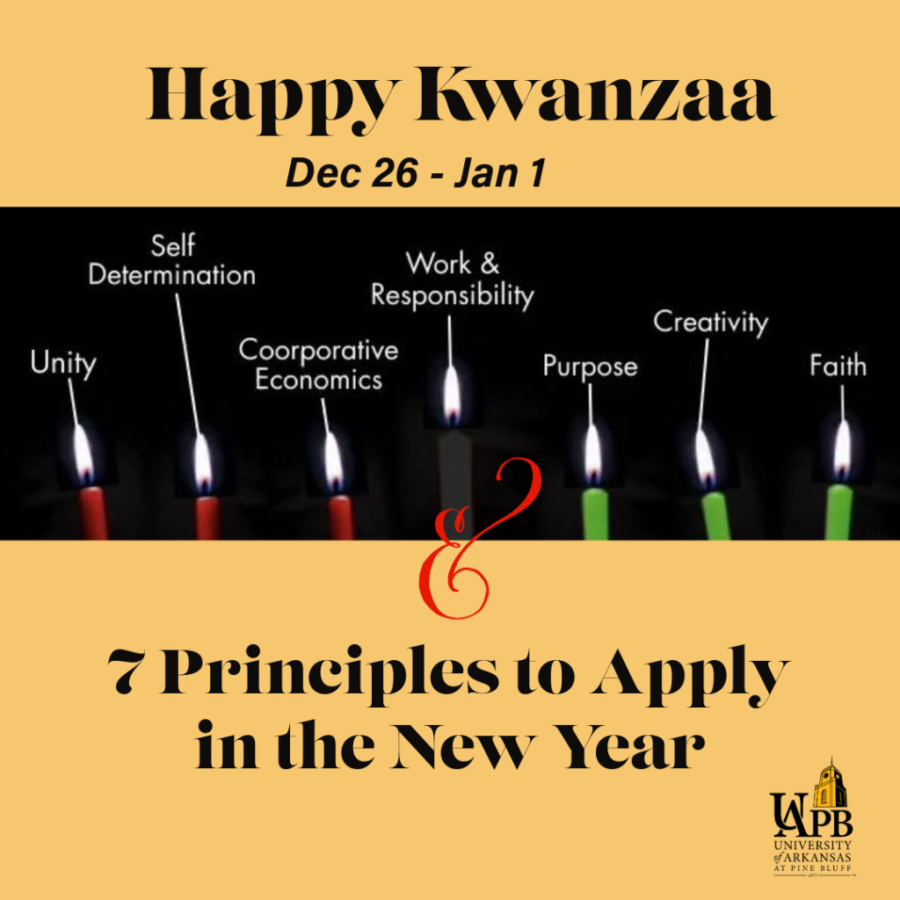
Each of the seven days of Kwanzaa is dedicated to a principle, which gives each day a specific meaning and purpose on which to focus. The seven principles are unity, self-determination, collective work and responsibility, cooperative economics, purpose, creativity and faith.

The colors of Kwanzaa

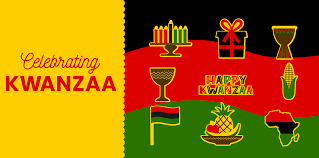
The colors of Kwanzaa are black, red and green, and they’re used to represent unity for people of African descent worldwide. Black represents the people, red for the noble blood that unites them and green for the rich land of Africa.

The meaning of the candelabra
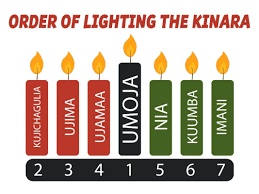
A seven-branched candelabra called a kinara is used to help discuss and celebrate the principles, with a new candle being lit each night. One is black, three are red and three are green, and the black candle is placed in the center. The black candle, which represents unity, is lit on the first day of Kwanzaa. Red candles are placed to the left and green to the right and are lit in that order. The order of the candles indicates that the people come first, followed by the struggle and then hope.

The importance of food

Food is an important part of many holidays, and Kwanzaa is no exception. Many people celebrate with their favorite African-American dishes – along with traditional African, Caribbean and other appropriate recipes – throughout the week. The holiday culminates with a feast (known as Karamu) on Dec. 31, with dishes meant to symbolize the past as well as the current growth of African cultur
Filed Under: Community, The Featured Articles Tagged With: Kwanzaa

Kawanzaa Starts Tonight

December 26, 2024 By Dayton Most Metro

The name Kwanzaa is derived from the phrase “matunda ya kwanza” which means “first fruits” in Swahili. Each family celebrates Kwanzaa in its own way, but celebrations often include songs and dances, African drums, storytelling, poetry reading, and a large traditional meal.

The candle-lighting ceremony each evening provides the opportunity to gather and discuss the meaning of Kwanzaa. The first night, the black candle in the center is lit (and the principle of umoja/unity is discussed). One candle is lit each evening and the appropriate principle is discussed.

Seven Principles

The seven principles, or Nguzo Saba are a set of ideals created by Dr. Maulana Karenga. Each day of Kwanzaa emphasizes a different principle.

Unity:Umoja (oo–MO–jah)
To strive for and maintain unity in the family, community, nation, and race.

Self-determination: Kujichagulia (koo–gee–cha–goo–LEE–yah)
To define ourselves, name ourselves, create for ourselves, and speak for ourselves.

Collective Work and Responsibility: Ujima (oo–GEE–mah)
To build and maintain our community together and make our brother’s and sister’s problems our problems and to solve them together.

Cooperative Economics: Ujamaa (oo–JAH–mah)
To build and maintain our own stores, shops, and other businesses and to profit from them together.

Purpose: Nia (nee–YAH)
To make our collective vocation the building and developing of our community in order to restore our people to their traditional greatness.

Creativity: Kuumba (koo–OOM–bah)
To do always as much as we can, in the way we can, in order to leave our community more beautiful and beneficial than we inherited it.

Faith: Imani (ee–MAH–nee)
To believe with all our heart in our people, our parents, our teachers, our leaders, and the righteousness and victory of our struggle.

Seven Symbols

The seven principles, or Nguzo Saba are a set of ideals created by Dr. Maulana Karenga. Each day of Kwanzaa emphasizes a different principle.

Mazao, the crops (fruits, nuts, and vegetables)
Symbolizes work and the basis of the holiday. It represents the historical foundation for Kwanzaa, the gathering of the people that is patterned after African harvest festivals in which joy, sharing, unity, and thanksgiving are the fruits of collective planning and work. Since the family is the basic social and economic center of every civilization, the celebration bonded family members, reaffirming their commitment and responsibility to each other. In Africa the family may have included several generations of two or more nuclear families, as well as distant relatives. Ancient Africans didn’t care how large the family was, but there was only one leader – the oldest male of the strongest group. For this reason, an entire village may have been composed of one family. The family was a limb of a tribe that shared common customs, cultural traditions, and political unity and were supposedly descended from common ancestors. The tribe lived by traditions that provided continuity and identity. Tribal laws often determined the value system, laws, and customs encompassing birth, adolescence, marriage, parenthood, maturity, and death. Through personal sacrifice and hard work, the farmers sowed seeds that brought forth new plant life to feed the people and other animals of the earth. To demonstrate their mazao, celebrants of Kwanzaa place nuts, fruit, and vegetables, representing work, on the mkeka.

Mkeka: Place Mat
The mkeka, made from straw or cloth, comes directly from Africa and expresses history, culture, and tradition. It symbolizes the historical and traditional foundation for us to stand on and build our lives because today stands on our yesterdays, just as the other symbols stand on the mkeka. In 1965, James Baldwin wrote: “For history is not merely something to be read. And it does not refer merely, or even principally, to the past. On the contrary, the great force of history comes from the facts that we carry it within us, are consciously controlled by it in many ways, and history is literally present in all that we do. It could scarcely be otherwise, since it is to history that we owe our frames of reference, our identities, and our aspirations.” During Kwanzaa, we study, recall, and reflect on our history and the role we are to play as a legacy to the future. Ancient societies made mats from straw, the dried seams of grains, sowed and reaped collectively. The weavers took the stalks and created household baskets and mats. Today, we buy mkeka that are made from Kente cloth, African mud cloth, and other textiles from various areas of the African continent. The mishumaa saba, the vibunzi, the mazao, the zawadi, the kikombe cha umoja, and the kinara are placed directly on the mkeka.

Vibunzi: Ear of Corn
The stalk of corn represents fertility and symbolizes that through the reproduction of children, the future hopes of the family are brought to life. One ear is called vibunzi, and two or more ears are called mihindi. Each ear symbolizes a child in the family, and thus one ear is placed on the mkeka for each child in the family. If there are no children in the home, two ears are still set on the mkeka because each person is responsible for the children of the community. During Kwanzaa, we take the love and nurturance that was heaped on us as children and selflessly return it to all children, especially the helpless, homeless, loveless ones in our community. Thus, the Nigerian proverb “It takes a whole village to raise a child” is realized in this symbol (vibunzi), since raising a child in Africa was a community affair, involving the tribal village, as well as the family. Good habits of respect for self and others, discipline, positive thinking, expectations, compassion, empathy, charity, and self-direction are learned in childhood from parents, from peers, and from experiences. Children are essential to Kwanzaa, for they are the future, the seed bearers that will carry cultural values and practices into the next generation. For this reason, children were cared for communally and individually within a tribal village. The biological family was ultimately responsible for raising its own children, but every person in the village was responsible for the safety and welfare of all the children.


Excerpted from the book: The Complete Kwanzaa Celebrating Our Cultural Harvest. Copyright 1995 by Dorothy Winbush Riley.

Filed Under: Community, The Featured Articles Tagged With: Kwanzaa

Primary Sidebar

Submit An Event to Dayton937

- Featured Events -

7 events found.
  • Previous week
  • Next week
Notice
No events scheduled for June 1, 2026.
Notice
No events scheduled for June 2, 2026.
Trivia Night at Alematic

Trivia Night at Alematic

7:00 pm
Alematic Artisan Ales
Fun Trivia! Prizes!

Fun Trivia! Prizes!

7:00 pm
Bock Family Brewing
Dayton Pride 2026

Dayton Pride 2026

6:00 pm
PRIDE
Notice
No events scheduled for June 6, 2026.
Dayton Poetry Slam

Dayton Poetry Slam

7:30 pm
yellow cab tavern

Week of Events

Mon 1
Tue 2
Wed 3
Thu 4
Fri 5
Sat 6
Sun 7
June 3, 2026 7:00 pm - 9:00 pm Recurring
Trivia Night at Alematic
June 3 @ 7:00 pm - 9:00 pm Recurring

Trivia Night at Alematic

Grab some friends and join us every Wednesday night at the brewery for a pint of your favorite ALEMATIC brew...

June 4, 2026 7:00 pm - 9:00 pm Recurring
Fun Trivia! Prizes!
June 4 @ 7:00 pm - 9:00 pm Recurring

Fun Trivia! Prizes!

Please join us every Thursday from 7-9 for trivia at Bock Family Brewing!  Prizes available for 1st and 2nd place...

Free
June 5, 2026 6:00 pm - 10:00 pm
Dayton Pride 2026
June 5 @ 6:00 pm - 10:00 pm

Dayton Pride 2026

Save the dates! Dayton Pride 2026 will be Friday, June 5 and Saturday, June 6, 2026.

June 7, 2026 7:30 pm Recurring
Dayton Poetry Slam
June 7 @ 7:30 pm Recurring

Dayton Poetry Slam

Dayton's longest running poetry show is celebrating it's 24th year.  Open mics, competitions, and featured poets await you twice a...

$3
View Calendar

Join the Dayton937 Newsletter!

Trust us with your email address and we'll send you our most important updates!
Email:  
For Email Marketing you can trust
Back to Top

Copyright © 2026 Dayton Most Metro · Terms & Conditions · Log in