


The Famous Restaurant
953 S. Main St,
Centerville, OH 45458
953 S. Main St,
Centerville, OH 45458
937-951-2422
Hours:
Monday – Saturday: 11AM – 10PM
Sunday: 11AM – 9PM
Sunday: 11AM – 9PM
Things to do in Dayton | Restaurants, Theatre, Music and More
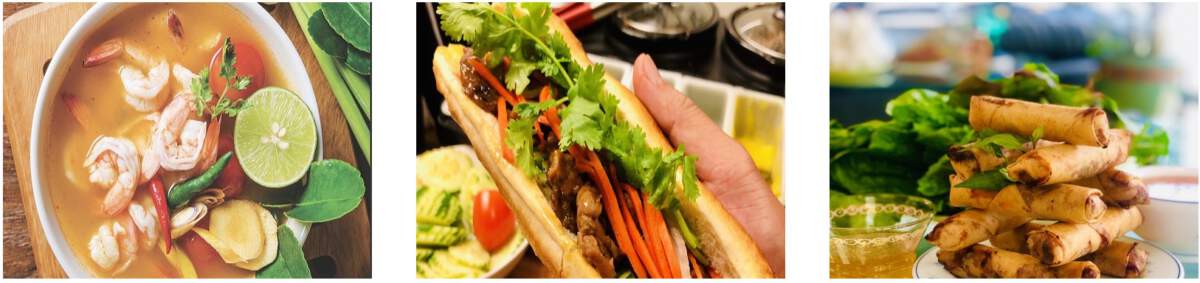
Celebrate 40 years of The Temptations and The Four Tops, and the 60th Anniversary of the hit song “My Girl,” when the two legendary groups reunite in Huber Heights, OH for a special performance at Rose Music Center on Thursday, August 7.

THE TEMPTATIONS
The Temptations, often referred to as American music royalty, are world-renowned superstars of entertainment, revered for their phenomenal catalog of music and prolific career. They are one of the most iconic, bestselling brands in the entertainment world today. While the group has evolved over the years, Dr. Otis Williams has continued to lead the group and carry the torch forward for the next generation of Temptations fans. The Temptations are headlining concerts around the country throughout 2025. Their concerts include fan favorites such as “My Girl,” “Just My Imagination (Running Away with Me),” “Ain’t Too Proud to Beg,” “Papa Was a Rollin’ Stone,” and more.
Ranked #1 in Billboard magazine’s most recent list of the “Greatest R&B/Hip-Hop Artists of All Time,” The Temptations also appear in the magazine’s 125th Anniversary list of the “125 Greatest of All Time Artists.” In addition, Rolling Stone magazine named the group among the “100 Greatest Artists of All Time.” In September of 2020, the editors of Rolling Stone magazine commented that The Temptations are “Indisputably the greatest black vocal group of the Modern Era…,” and listed the group’s Anthology album among the “500 Greatest Albums of All Time.” The Anthology album has appeared in all three of Rolling Stone’s 500 Greatest Albums’ lists.
The Temptations have been the subject of a smash hit Broadway musical, Ain’t Too Proud: The Life and Times of The Temptations, based on Otis Williams’ personal journey, which opened on Broadway at the Imperial Theatre on March 21st, 2019. The musical received 12 Tony nominations, including Best Musical, and won the Tony Award® for Best Choreography at the 73rd Tony Awards at Radio City Music Hall in New York City on June 10, 2019. The Temptations’ heritage, influence, and contributions to not only American culture and African American communities but also to the global music landscape are monumental. The Temptations’ presence in the world today has never been more vivid, and their popularity is ever-increasing.
THE FOUR TOPS
The legendary quartet, originally called the Four Aims, made their first Motown hit, “Baby I Need Your Loving” in 1964, made them stars and their sixties track record on the label is indispensable to any retrospective of the decade.
Their songs, soulful and bittersweet, were across-the-board successes. “I Can’t Help Myself (Sugar Pie, Honey Bunch),” a no. 1 R&B and Pop smash in 1965, is one of Motown’s longest-running chart toppers; “It’s The Same Old Song” (no. 2 R&B/no. 5 pop), no. 1 “Reach Out I’ll Be There,” “Standing In The Shadows Of Love” (no. 2 R&B/no. 6 pop) and “Bernadette” (no. 3 R&B/no. 4 pop). Other Tops hits include “Ask The Lonely,” “Shake Me, Wake Me (When It’s Over),” “Something About You,” “You Keep Running Away,” “7-Rooms Of Gloom” and many more.
In 1990, with 24 Top-40 pop hits to their credit, the Four Tops were inducted into the Rock & Roll Hall Of Fame. Though they would no longer have hits on record, the group continued to be a hit in concert, touring incessantly, a towering testament to the enduring legacy of the Motown Sound they helped shape and define.
“The Four Tops will always be one of the biggest and the best groups ever. Their music is forever.” – Smokey Robinson
ickets will go on sale to the public beginning at 10AM on Friday, April 4 at Ticketmaster.com and the Rose Music Center Box Office.
free but reservations required:
https://am.ticketmaster.com/rogerglass/buy/themusicofstarwars
Conversation with Chef Cece of The Burger Bistro, one of the four restaurants at The Silos (801 East First). I asked Chef Cece about her food background.


Shop owners Aiden and Dee are down and out and on the verge of losing everything. One lucky customer has their ticket out of the poorhouse—they just need to get their hands on it without her knowing.
CHANCERS by Robert Massey is a fast and furious comedy set in 2014 County Kildare, Ireland. The country is still reeling from the 2008 recession which followed the economic Celtic Tiger boom of the previous two decades. Aiden and Dee are married with kids and are barely scraping by, trying to keep their corner convenience store and their family from total bankruptcy. Their friend J.P . is in even worse shape, drifting from one get-rich scheme to the next. Gertie is a cranky, nosy older woman who has done quite well for herself financially through her miserly ways and cutthroat land deals. A winning lottery ticket in Gertie’s possession becomes the center of the plot and the central question of the play: When being a good person gets you nothing, how far will you go when your back is against the wall?
Run time: Act 1: 55 Minutes. Intermission: 15 Minutes. Act 2: 45 Minutes.
Inspired by the vibrant culture of street tacos, Taco Bell’s Toasted Cheddar Street Chalupas revive the fan-favorite street chalupas with a bold new edge: a crispy new exterior and craveable sauce. Street food is all about bold flavors, bright ingredients and a touch of creativity and this next evolution in Taco Bell’s ode to street food culture infuses the best of traditional street tacos – simple ingredients like onions and cilantro – into a crispy toasted cheddar shell and a new Chile Lime Crema Sauce. This new menu item provides a new flavor experience that’s craveable from the outside in.
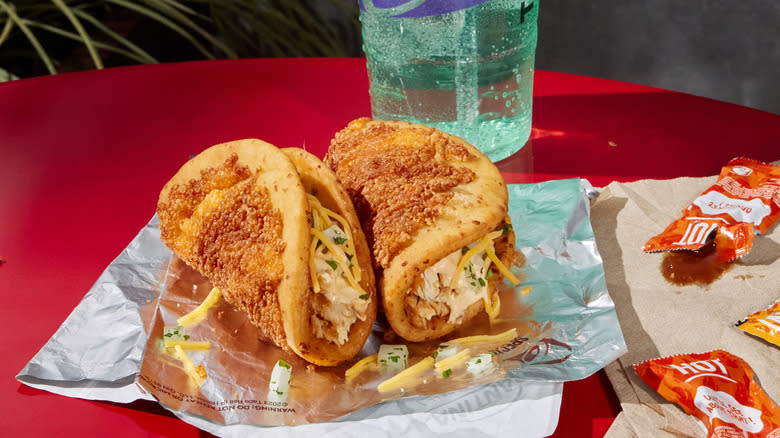
Building on a legacy of bold chalupa innovations, Taco Bell is merging two fan-favorite menu creations from the past – the Toasted Cheddar Chalupa from 2019 and last year’s Cheesy Street Chalupas – to deliver the ultimate mashup of crispy, cheesy and street-inspired indulgence. The new menu item is now available nationwide for $5.49 a la carte starting March 27, for a limited time while supplies last.
“The street taco is a cultural staple built on bold flavor and quality ingredients, and the Toasted Cheddar Street Chalupas honors that tradition while bringing in a unique Taco Bell touch that packs even more flavor into every bite,” said Luis Restrepo, Taco Bell’s Vice President, Product Innovation. “Fans immediately fell in love with the crispy, cheesy bite of the Toasted Cheddar Chalupa in 2019, and now we’re elevating that street-inspired flavor experience and that’s exactly the kind of comeback our fans have been waiting for.”
Unique Tasting Experience with Flavors That Hit from the Outside In
The Toasted Cheddar Street Chalupas deliver a striking first impression with layers of flavor inside and out. Here’s the breakdown:
Toasted Cheddar Street Chalupas are available for a limited time at participating Taco Bell locations nationwide, starting at $5.49 for two chalupas (same protein per order).
 Piada Italian Street Food recently announced the launch of its new Piada Pockets in three crave-worthy flavors: Spinach & Artichoke, Meatball Marinara, and Spicy Sausage. Baked to perfection in Piada’s signature dough and packed with bold Italian flavors, Piada Pockets will be available at all locations.
“Our Piada Pockets capture everything guests love about Italian food—rich flavors, high-quality ingredients, and a warm, satisfying bite—all in a portable format,” said Matt Harding, Chief Concept Officer at Piada Italian Street Food. “Whether you’re craving the classic comfort of meatballs and marinara, the indulgence of creamy spinach and artichoke, or the bold heat of spicy sausage and peppers, there’s a Piada Pocket for every taste.”
Piada Pockets aren’t just delicious—they’re also a way to give back. From March 24th – March 30th, Piada will donate $1 from every Piada Pocket sold to Pelotonia, supporting life-saving cancer research, with a commitment of up to $10,000. Additionally, anyone who orders a Piada Pocket online during this week will be entered to win one of five exciting prizes, including a $500 Piada gift card + an exclusive influencer pack or one of four $100 gift cards.
“Our goal was to take our signature Piada dough and create something truly irresistible,” said Dawn McClung, Research and Development Chef at Piada Italian Street Food. “After three years in the making, these pockets are a perfect balance of crisp, golden-baked dough and indulgent, high-quality fillings. They’re easy to eat on the go, but still bring that comforting, made-from-scratch Italian experience.”
Piada Pockets will be available at all Piada Italian Street Food locations nationwide. For more information and to order, visit mypiada.com or download the Piada One app.
Piada Italian Street Food
1047 Miamisburg-Centerville Rd
Dayton, OH 45459
4397 Far Hills Ave
Kettering, OH 45429
3286-B Pentagon Blvd
Beavercreek, OH 45431
This series was inspired by words – President Trump’s lies about the Haitian immigrants in Springfield. I’ve decided that I should try to include words in the images I’m creating. I should use my words to combat those of the president.
Lies and slander are part of the president’s schtick, the comedic style he uses to entertain his followers. Wikipedia lists more than 80 of his derogatory nicknames, like calling his predecessor “Crooked Joe.” The president uses those nicknames to demean other powerful people. It’s different when his slurs are directed at the most vulnerable.
When powerful people direct hate speech against the vulnerable I hear echoes of some of history’s worst events. Calling Haitians criminals who eat people’s dogs and cats makes me think of the Tutsis who were called cockroaches before the killings in Rwanda, or the Jews who were called vermin before their German citizenship was stripped away. Words aimed at dehumanizing the vulnerable can be a first step towards abuse. When we hear those words we need to shout them down.
Miguel’s parents brought him here to escape the violence in his native country. He has no documentation, so the president labels him a criminal. We cannot let that label stand. It can be used to justify abuses, claiming they were acceptable because they were directed only against criminals.
If the president wants to label some people as criminals, we should insist that he use the word accurately. A criminal is a person who has been found guilty in a court of law of committing a crime. The president is a criminal. Miguel is not.
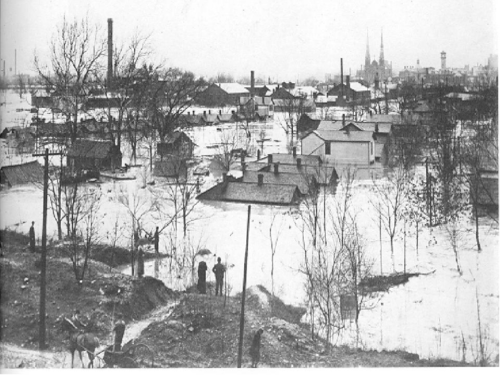 During March 1913, the citizens of the Miami Valley experienced a natural disaster unparalleled in the region’s history. Within a three-day period, nine to 11 inches of rain fell throughout the Great Miami River Watershed. The ground was already saturated from the melting of snow and ice of a hard winter. The ground could absorb little of the rain. The water ran off into streams and rivers, causing the Great Miami River and other rivers to overflow. Every city along the river was overrun with floodwater. Altogether, nearly four trillion gallons of water, an amount equivalent to about thirty days of discharge of water over Niagara Falls, flowed through the Miami Valley during the ensuing flood.
Many residents climbed to the second floor and into attics of their homes to escape death from the floodwaters that raced and swirled uncontrollably in the freezing temperatures of March. In the pitch black of night, cries for help and the eerie groaning of houses being ripped off of their foundations filled the sky as the waters continued to rise. With no functional telegraph lines, the flood survivors were completely cut off from the outside world.
Rushing torrentially, the waters swept away bridges, dwellings, and commercial buildings — and anyone who was in them. It precipitated fires at broken gas mains, which spread when fed by spilled gasoline. In Dayton, a fire erupted at a drug store, consuming nearly two blocks of business buildings (now named the “Fireblocks”). At Hamilton, within two hours the flood swept away three of the four bridges, and destroyed the fourth a few hours later.
During those long hours waiting for the waters to recede, residents made a promise to one another: Never Again.
In the Miami Valley, more than 360 people lost their lives. Property damage exceeded $100 million (that’s more than $3.2 billion in today’s economy). Despite the tragedy, the citizens of the Miami Valley, who had lost virtually everything, rallied to raise money for a plan to stop flooding once and for all. Some 23,000 citizens contributed their own money – adding up to more than 2 million dollars – to begin a comprehensive flood protection program on a valley-wide basis.
Today, reminders of how our communities overcame live on. Read below to discover eight ideas for exploring (and tasting?) Great Flood history along the Great Miami Riverway.
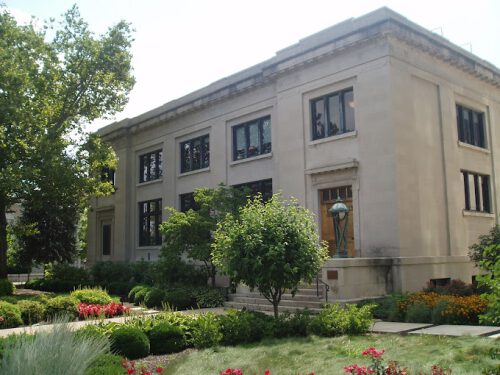 1. Visit Miami Conservancy District Historic Headquarters
The three-story building, including basement, is built of Indiana (Bedford) limestone. Colonel Edward Deeds announced in July of 1915 that he would gift a headquarters building to the Miami Conservancy District. The building was designed and constructed in about six months, with staff moving in at the beginning of 1916. The lobby features original light fixtures, staircase and moldings. The first-floor ceilings are coffered and feature larger replicas of the original lighting fixtures.
In his letter to the Board of Directors, Edward Deeds wrote that “engineers from all quarters will be coming to the Miami Valley to study our work. We owe it to the people of the flood stricken valleys of the world to make this data complete and permanently available”.
While you are free to explore the exterior of the building (we recommend enjoying lunch in our pocket park), we recommend scheduling private tours of the interior. This is for the safety and comfort of our staff, who still use the building to this day. Please contact Sarah Hippensteel Hall via our contact form to request a tour!
More about our Headquarter Building
About the art exhibit displayed inside Headquarters
2. Admire ‘Fractal Rain’ at the Dayton Metro Library Main Campus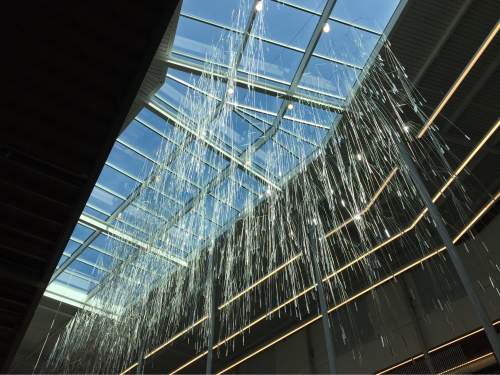
The impressive sculpture by Terry Welker is named“Fractal Rain”. It is is fashioned of 3,500 six-inch prisms on nearly five miles of stainless-steel wire. The dramatic piece, which hangs from the third floor under a skylight and cascades down to the floors below, changes as it catches the light at different times of day. One in every six of the prisms has been optically dyed in studio in Monet colors — lavender, green, blue, yellow, and pink.
The piece, according to Welker, references the Great Dayton Flood of 1913 and our city’s love/hate relationship with rain.
The 1,000-pound piece was selected by the internationally known Collaboration of Design and Art as one of the “top 100 most successful design projects that integrate commissioned art into an interior, architectural or public space” (From Dayton Daily News)
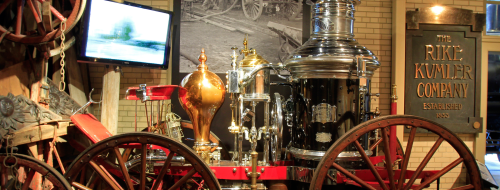 3. Explore the Great 1913 Flood Exhibit at Carillon Historical Park
The Great 1913 Flood Exhibit features stories of disaster, perseverance, and heroism. By bringing together numerous flood-related artifacts, the exhibit tells the story of a grief-stricken city banding together to rise above adversity.
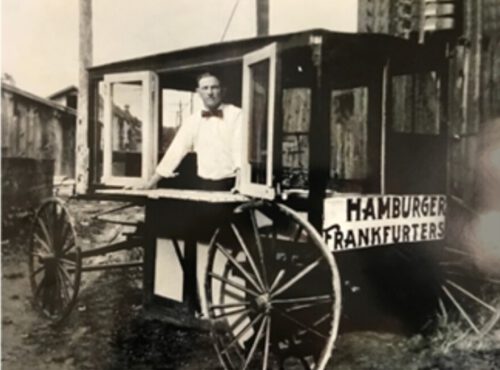 4. Taste a Piece of History at the Hamburger Wagon
The famous little Hamburger Wagon in Miamisburg has some unique flood history. After the flood waters receded and disaster relief was in dire need, Miamisburg resident Sherman “Cocky” Porter used a family recipe to serve up delicious hamburgers to flood refugees for many days. When life finally returned to normal, Miamisburg residents loved the little “Porter Burgers” so much that Porter agreed to start selling them on Saturdays. The business grew from there, and ever since it has been a community staple, ranked one of the top 100 hamburgers in the United States by Hamburger America.
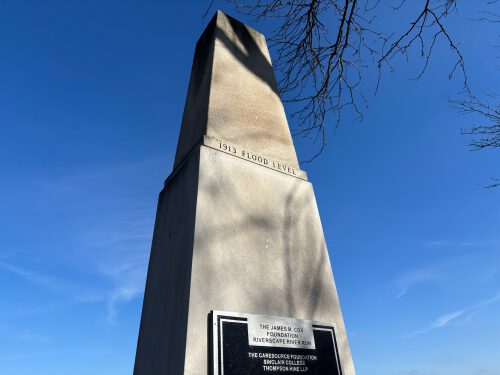 5. Search for Flood Depth Markers
In many riverfront cities along the Great Miami River evidence of the 1913 flood depth can be found at various flood depth markers. While you are enjoying local restaurants or retail stores in one of the historic downtowns, keep your eyes peeled for these markers and statues.
Many communities along the Great Miami River such as Troy, Dayton, West Carrollton, Miamisburg, Middletown, and Hamilton have done an excellent job maintaining flood markers to showcase the height of the flood. Markers can be found as stand-alone statues, on buildings or bridges as stone or metal plaques, or can be found wrapped on light poles and fixtures. See how many you can find!
Statue in Hamilton near the Great Miami Rowing Center
High water mark at Riverscape MetroPark in Dayton
High water mark on the Market Square Building in Miamisburg
6. Follow the remnants of the Miami-Erie Canal Along the Great Miami River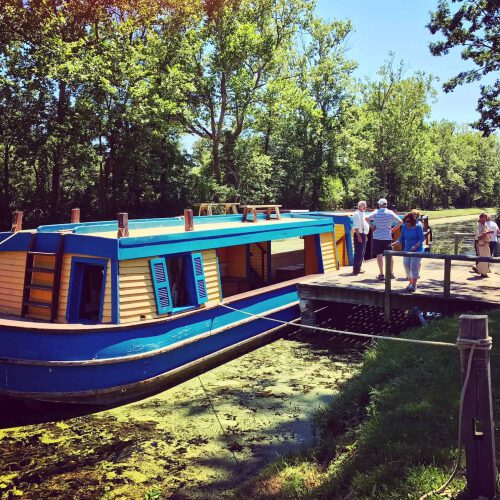
The Miami and Erie Canal was 274 miles long, connecting Cincinnati to Toledo – the Ohio River to Lake Erie. Construction began in 1825 at a cost of $8 million. In today’s money? That’s $177 million. At its peak, the canal had 103 locks and featured feeder canals, man-made reservoirs, and guard stations.
As railroad systems were introduced and found to be a more reliable and cheaper mode of transporting goods, the Ohio canals saw less and less use. Various attempts at canal revival were made between 1904 and 1910, however, the Great Flood of 1913 caused the reservoirs to spill over into the canals, destroying aqueducts, washing out banks, and devastating most of the locks.
Luckily, history lives on. Throughout the Great Miami Riverway, you can find pieces of the original canal and many other places that celebrate its history. Here is a guide to view pieces of the canal today along the river. In Piqua, you can even ride the canal in a canal boat called General Harrison.
7. Take a walk through the beautiful Woodland Cemetery and Arboretum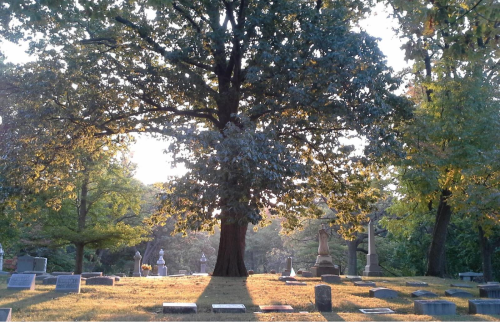
Many flood heroes are buried like John Henry Patterson, who shut down his cash register factory to build rescue boats and provide housing and shelter to flood victims, or James M. Cox, whose leadership helped secure state aid for flood victims and establish the Miami Conservancy District. The land of the cemetery itself was a refuge for many escaping the flood waters in Dayton due to its higher elevation.
8. Visit the 5 dry dams that continue to protect the region from flooding to this day.
Within weeks of the Great Flood of 1913, community leaders hired engineer Arthur Morgan to develop a regional flood protection system, which was awarded the 1922 Engineering Record’s distinguished “Project of the Year,” placing it in a category with other international engineering design feats like the Brooklyn Bridge (1883), Eiffel Tower (1889), Empire State Building (1931), Golden Gate Bridge (1937), Gateway Arch (1965) and the Channel Tunnel (1994).
 The flood protection system is designed to manage a storm the size of the Great Flood of 1913 plus an additional 40 percent. The drainage patterns of the entire Great Miami River Watershed are incorporated into its design. The 5 dry dams and 55 miles of levees operate without human intervention and have no moving parts, except floodgates on storm sewers along the levees. They are called dry because the dams are used only to store floodwaters after heavy rainfall. The remainder of the time, the storage land upstream of each dam – 35,650 acres – is used predominantly for parkland and farmland. The Miami Conservancy District partners with many park districts to enable outdoor recreation opportunities on these flood protection lands. Learn more about the system and visiting the dams with the links below:
Dry Dams
Germantown
Taylorsville
Englewood
Huffman
Lockington
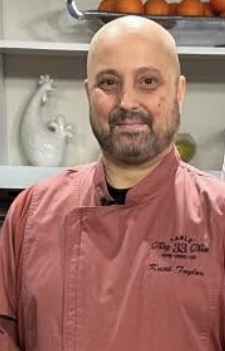
Chef Keith Taylor
Table 33 is hosting an exclusive wine dinner with a special menu created by Executive Chef, Keith Taylor, and Sous Chef, Justin Gall, paired with Titus Wines on Wed, May 7th. There will be two seatings, 5:30pm or 7:30pm. Joining them for the wine pairing will be Dinner with Napa Valley Winemaker & Owner of Titus Wines, Eric Titus.

Miami Valley Meals (MVM) marks its 5th anniversary today, Tuesday, March 25, 2025, honoring five years of transforming donated and rescued food into nutritious meals for those experiencing food insecurity. What began as a small group of furloughed culinary and hospitality professionals responding to the pandemic has grown into an impactful nonprofit that now serves over 4,000 meals weekly across the Miami Valley.
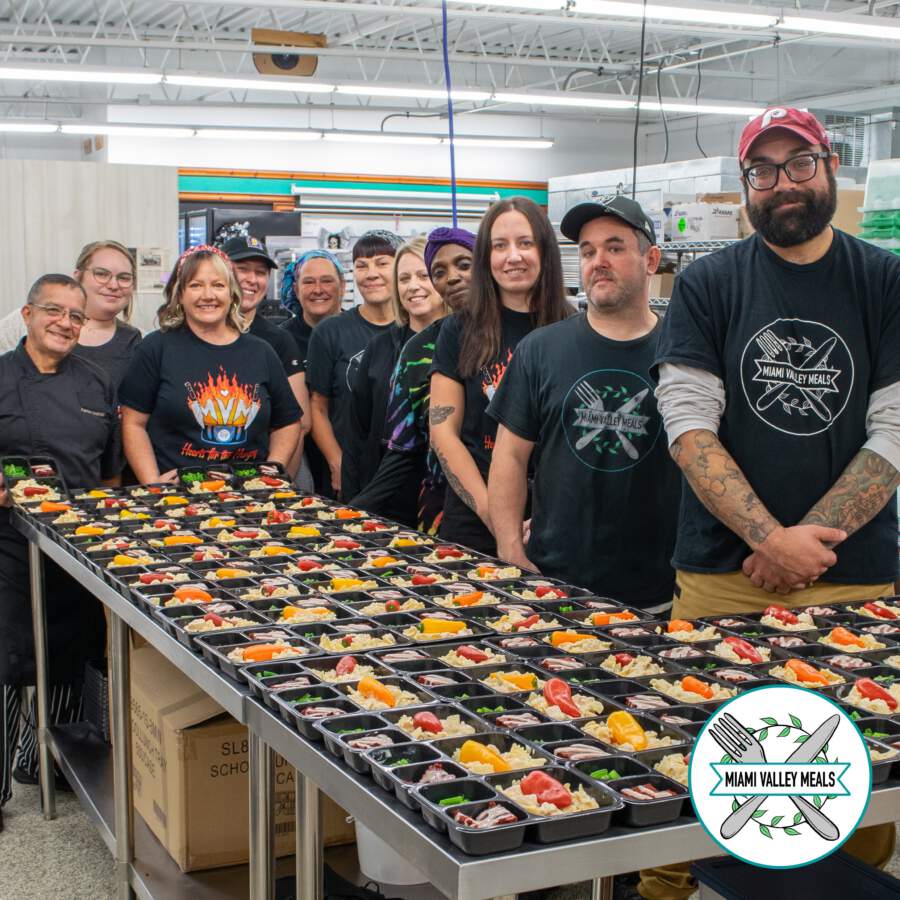
Since its founding in 2020, MVM has provided over 1 million meals, collaborating with more than 129 nonprofit partners to ensure access to high-quality, chef-prepared meals. By sourcing over 90% of its ingredients from rescued and donated food, MVM not only nourishes the community but also plays a critical role in reducing food waste. The meals additionally serve as a connection to additional wrap-around services through their network of nonprofit partners.

Amanda DeLotelle
“Our journey started with a simple question—‘How can we help?’—and five years later, that same spirit of service and collaboration continues to drive us,” said Amanda DeLotelle, Executive Director and Co-Founder of Miami Valley Meals. “The need in our community has only grown, but so has the support. We are grateful for our volunteers, partners, and donors who make it possible to serve nutritious meals with dignity and love.”

As MVM celebrates this milestone, the organization remains committed to expanding its impact. Hunger persists in the Miami Valley, with 1 in 7 people facing food insecurity and a growing waitlist for their meals. MVM invites the community to get involved—through volunteerism, donations, or partnerships—to help sustain this mission for years to come.
To learn more about Miami Valley Meals or to support its work, visit miamivalleymeals.org.
 Several people have suggested I post about Heart Mercantile because they’ve done so many good things for Dayton, so I stopped by recently and met Kait. I asked her how long the business has been in operation.


